Land and People of Nigeria

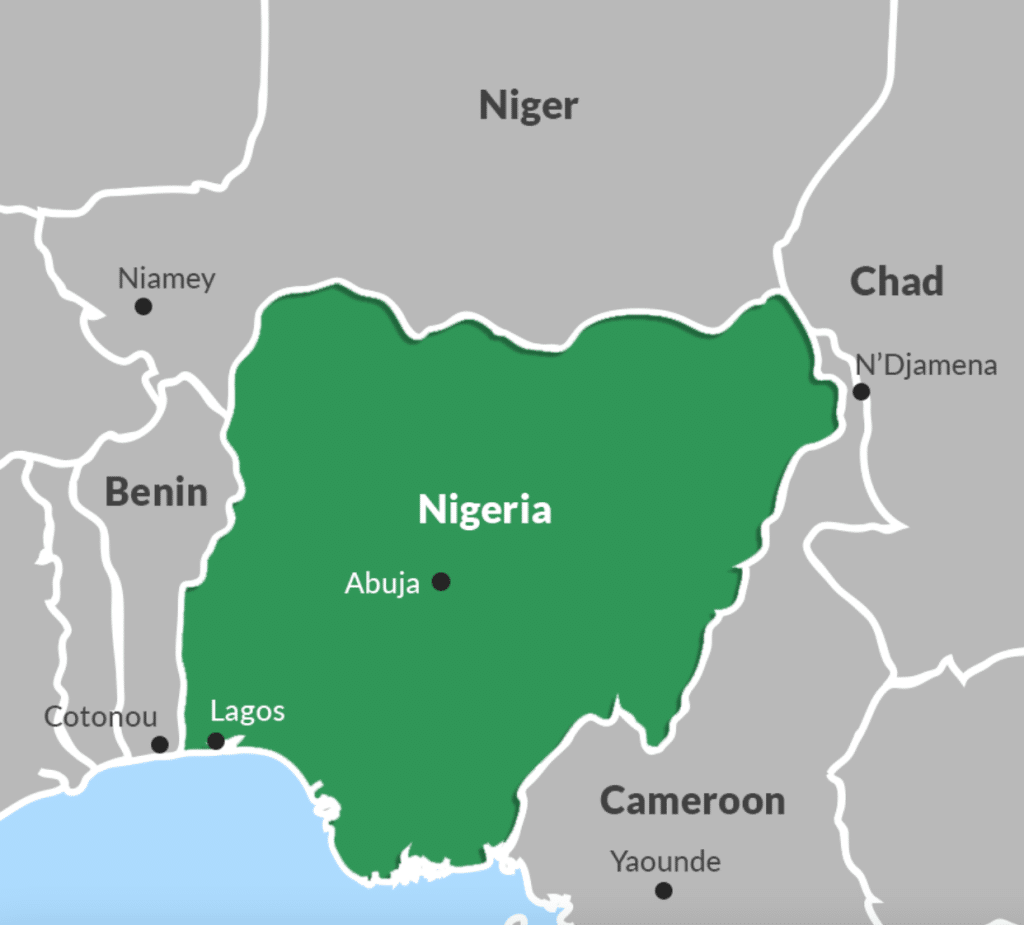
Nigeria – Land and People: Nigeria is the most populous country in Africa, located in West Africa between latitudes 4°N and 14°N, and longitudes 3°E and 15°E. It covers 923,768 square kilometers, bordered by Benin, Niger, Cameroon, and the Atlantic Ocean, with diverse geographical zones that influence the activities and cultures of over 250 ethnic groups.

Quick Summary: Nigeria’s Geography

  • Location: West Africa, between latitudes 4°N-14°N and longitudes 3°E-15°E
  • Size: 923,768 square kilometers (almost four times the size of United Kingdom)
  • Borders: Benin (west), Niger (north), Cameroon (east), Atlantic Ocean (south)
  • Main rivers: Niger and Benue divide the country into three relief blocks
  • Six geopolitical zones with distinct physical features and climates

Location of Nigeria

Nigeria is located in West Africa, on the curve that forms the eastern border of the West African sub-region. The country sits in a strategic position along the Gulf of Guinea coast.

Nigeria lies between latitude 4°N and 14°N of the equator, and between longitude 3°E and 15°E of the Greenwich Meridian. This means Nigeria is north of the equator (in the Northern Hemisphere) and east of the Prime Meridian.

Think of Nigeria’s position this way: if you draw a line from north to south through Nigeria, you would cover about 10 degrees of latitude. That is roughly 1,100 kilometers. From west to east, the country spans about 12 degrees of longitude, covering approximately 1,200 kilometers.

Nigeria’s Boundaries

Nigeria shares land borders with four countries:

  • West: Republic of Benin (formerly Dahomey)
  • North: Niger Republic
  • East: Republic of Cameroon
  • Northeast: Chad (at Lake Chad)
  • South: Atlantic Ocean (Gulf of Guinea)

The southern boundary along the Atlantic Ocean gives Nigeria access to the sea. This is important for international trade. Nigeria’s major seaports include Lagos (Apapa and Tin Can Island), Port Harcourt, Warri, and Calabar.

The land borders were mostly drawn by European colonial powers during the Berlin Conference of 1884-1885. This explains why some ethnic groups (like the Yoruba) are found in both Nigeria and Benin Republic, or why the Hausa-Fulani extend into Niger Republic.

Size and Population

Nigeria has a total land area of 923,768 square kilometers (356,669 square miles). To put this in perspective, Nigeria is almost four times larger than the United Kingdom. It is the 32nd largest country in the world by land area.

Nigeria is the most populous country in Africa. As of 2023, the population exceeds 220 million people, making it the 6th most populous country in the world. The country has over 250 ethnic groups, with the three largest being Hausa-Fulani (north), Yoruba (southwest), and Igbo (southeast).

This large population makes Nigeria a major market for goods and services in Africa. It also means Nigeria has significant influence in West African politics and economics through organizations like ECOWAS (Economic Community of West African States).

Main Physical Features

Rivers and Drainage

The two most important rivers in Nigeria are the River Niger and River Benue. These rivers divide the country into three main blocks.

River Niger is the third longest river in Africa (after the Nile and Congo). It enters Nigeria from Niger Republic in the northwest, flows southward through Nigeria, and empties into the Atlantic Ocean through the Niger Delta. The river is about 4,180 kilometers long in total, with roughly 1,400 kilometers flowing through Nigeria.

River Benue is the major tributary of River Niger. It enters Nigeria from Cameroon in the east and flows westward until it joins River Niger at Lokoja in Kogi State. The confluence (meeting point) of these two rivers is a major geographical landmark.

Other important rivers include River Kaduna, River Gongola, River Sokoto, River Ogun, River Osun, River Cross, and River Imo.

Highlands and Plateaus

Nigeria has several highland areas, mostly in the central and eastern regions:

Jos Plateau is the most extensive upland area in Nigeria. Located in Plateau State, it rises to heights between 2,000 and 4,000 feet above sea level. The plateau has a cooler climate compared to surrounding lowlands, making it suitable for temperate crops and tourism.

Adamawa Highlands are located in the east, along the border with Cameroon. This region contains Nigeria’s highest point – Chappal Waddi (also called Gangirwal) – which stands at 2,419 meters (7,936 feet) above sea level. The mountain is located in Taraba State.

Mambilla Plateau in Taraba State is another important highland region. It has an average elevation of about 1,600 meters, making it one of the highest plateaus in Nigeria. The area is known for tea cultivation.

Obudu Plateau in Cross River State is famous for the Obudu Mountain Resort, a popular tourist destination with cool weather and scenic views.

Western Highlands include elevated areas in Oyo, Ekiti, and Ondo States. While not as high as eastern highlands, they still create distinct features in the landscape.

Lowlands

Lowland areas are found mainly in:

  • The Niger-Benue valley (central Nigeria)
  • The coastal areas in the south
  • The Sokoto-Rima basin in the northwest
  • The Chad basin in the northeast

The Niger Delta is the largest wetland in Africa, formed where River Niger enters the Atlantic Ocean. This area is rich in oil and gas deposits, making it economically vital to Nigeria.

Geographical Zones of Nigeria

Nigeria can be divided into zones based on physical features, climate, and vegetation. The three main relief blocks are:

1. Western Relief Block

This area lies between the Middle Niger, Lower Niger, and Atlantic Ocean. It includes states like Lagos, Ogun, Oyo, Osun, Ondo, Ekiti, Kwara, and parts of Kogi.

2. Eastern Relief Block

Located between River Benue, Lower Niger, and the Atlantic Ocean. It includes states like Anambra, Enugu, Ebonyi, Abia, Imo, Rivers, Bayelsa, Delta, Akwa Ibom, and Cross River.

3. Northern Relief Block

The largest block, lying north of the Niger-Benue confluence. It includes all the northern states.

Climate Zones

Nigeria experiences a tropical climate with variations from south to north. There are three main climatic zones:

1. Tropical Monsoon Climate (Southern Nigeria)

This zone includes coastal states like Lagos, Rivers, Bayelsa, and Delta. It has:

  • Heavy rainfall (2,000-4,000 mm annually)
  • Long rainy season (March to October)
  • Short dry season (November to February)
  • High humidity throughout the year
  • Average temperature of 25-28°C

2. Tropical Savanna Climate (Central Nigeria)

This zone includes states in the Middle Belt like Benue, Plateau, Nasarawa, and parts of Kogi. It has:

  • Moderate rainfall (1,000-1,500 mm annually)
  • Rainy season from April to September
  • Dry season from November to March
  • Temperature range of 23-32°C

3. Sahelian Climate (Northern Nigeria)

This zone includes far northern states like Sokoto, Kano, Jigawa, Yobe, and Borno. It has:

  • Low rainfall (500-750 mm annually)
  • Short rainy season (June to September)
  • Long, hot dry season with harmattan winds
  • Temperature can reach 40°C during hot season
  • Cooler temperatures (15-20°C) during harmattan

Vegetation Zones

Nigeria’s vegetation follows the climate pattern, changing from south to north:

1. Mangrove Swamp Forest

Found along the coast, especially in the Niger Delta. Trees here have special roots that can survive in salt water. Economic activities include fishing, salt production, and palm oil extraction.

2. Freshwater Swamp Forest

Located just north of the mangrove zone, along river banks. The soil is waterlogged but not salty. Raffia palms and other water-loving plants grow here.

3. Tropical Rainforest

Found in southern and parts of central Nigeria. This zone has tall trees forming a thick canopy, heavy rainfall, and rich biodiversity. Economic trees include iroko, mahogany, and obeche. This zone supports cocoa, rubber, and oil palm cultivation.

4. Guinea Savanna

This is a transition zone between forest and grassland. It has scattered trees among tall grasses. Trees are shorter and more spread out than in rainforest. This zone is good for yam, cassava, and mixed farming.

5. Sudan Savanna

Found in the far north, this zone has short grasses and scattered short trees. The dry season is longer here. Farmers grow crops like millet, guinea corn (sorghum), and groundnuts. Cattle rearing is common.

6. Sahel Savanna

The northernmost vegetation zone, found in states like Yobe and Borno. It has patches of grass and sand, with very few trees. Desertification is a major problem here. Nomadic herding is the main occupation.

Geopolitical Zones

For administrative and political purposes, Nigeria is divided into six geopolitical zones:

Geopolitical Zone States Included Main Features
North Central Benue, FCT, Kogi, Kwara, Nasarawa, Niger, Plateau Middle Belt, confluence of Niger and Benue, Jos Plateau
North East Adamawa, Bauchi, Borno, Gombe, Taraba, Yobe Chad Basin, Adamawa Highlands, Sahel vegetation
North West Jigawa, Kaduna, Kano, Katsina, Kebbi, Sokoto, Zamfara Sokoto-Rima valley, Sudan savanna, commercial centers
South East Abia, Anambra, Ebonyi, Enugu, Imo Igbo heartland, coal deposits, commercial agriculture
South South Akwa Ibom, Bayelsa, Cross River, Delta, Edo, Rivers Niger Delta, oil and gas, coastal areas, rainforest
South West Ekiti, Lagos, Ogun, Ondo, Osun, Oyo Yoruba heartland, cocoa belt, commercial hub (Lagos)

Impact of Geography on Human Activities

Influence on Agriculture

The type of farming in each zone depends on climate, soil, and vegetation:

  • Rainforest zone: Tree crops (cocoa, rubber, oil palm, kola nut)
  • Guinea savanna: Root crops (yam, cassava), maize
  • Sudan savanna: Grains (millet, sorghum, rice), groundnuts, cotton
  • Sahel zone: Nomadic pastoralism (cattle, sheep, goats)

Influence on Settlement Patterns

Geography affects where people live:

  • Coastal areas attract fishing communities and port cities (Lagos, Port Harcourt, Calabar)
  • River valleys support agriculture and trade (settlements along Niger and Benue)
  • Plateaus attract people seeking cooler climate (Jos, Mambilla)
  • Northern plains support dispersed settlements due to pastoral lifestyle

Influence on Economic Activities

Natural resources found in different zones shape the economy:

  • Niger Delta: Oil and gas exploration, making it Nigeria’s economic backbone
  • Jos Plateau: Tin mining (though now declined)
  • Enugu: Coal mining
  • Southwest: Cocoa production for export
  • North: Groundnut pyramids (historically), livestock

Influence on Transportation

Rivers serve as natural highways for movement of goods and people. The Niger and Benue were important trade routes before modern roads. Coastal areas developed ports for international trade. Flat northern plains made it easier to build roads and railways.

Influence on Culture

Geography shapes culture and lifestyle:

  • Coastal people developed fishing skills and water transportation (canoes)
  • Forest dwellers became skilled at woodcarving and forest products
  • Northern herders developed nomadic culture adapted to semi-arid climate
  • Different foods reflect available crops (pounded yam in south, tuwo in north)

Common Exam Mistakes to Avoid

Based on WAEC Chief Examiner reports:

  • Confusing latitude and longitude: Remember, latitude runs east-west (horizontal lines measuring north-south position). Longitude runs north-south (vertical lines measuring east-west position).
  • Wrong boundary countries: Students often forget Chad or mix up Benin with Burkina Faso. Use the mnemonic “BNCG” – Benin, Niger, Cameroon, (Gulf of Guinea).
  • Mixing up relief blocks: Know which states belong to which block. The Niger and Benue rivers are the dividing lines.
  • Vague descriptions: Don’t just say “Nigeria is big.” Give the actual land area (923,768 sq km) and compare it to something (almost 4 times UK size).
  • Spelling errors: Common mistakes include “Adamaoua” (correct: Adamawa), “Chappal Wadi” (correct: Chappal Waddi), “Mambila” (correct: Mambilla).
  • Not linking geography to human activities: When asked about impact of geography, many students just describe the geography without explaining HOW it affects people.

Practice Questions

Multiple Choice Questions

1. Nigeria is located approximately between which latitudes?
(a) 10°N and 20°N
(b) 4°N and 14°N
(c) 0° and 10°N
(d) 4°S and 14°S
Answer: (b) ✓

2. The confluence of Rivers Niger and Benue is located in:
(a) Lagos State
(b) Kano State
(c) Kogi State
(d) Cross River State
Answer: (c) ✓

3. Nigeria’s highest point, Chappal Waddi, is located in:
(a) Plateau State
(b) Taraba State
(c) Adamawa State
(d) Cross River State
Answer: (b) ✓

4. Which vegetation zone is most suitable for cocoa cultivation?
(a) Sahel savanna
(b) Sudan savanna
(c) Tropical rainforest
(d) Mangrove swamp
Answer: (c) ✓

5. The Niger Delta is located in which geopolitical zone?
(a) South West
(b) South East
(c) South South
(d) North Central
Answer: (c) ✓

Essay/Theory Questions

1. (a) Draw an outline map of Nigeria. On the map, locate and name:
(i) Two major rivers (2 marks)
(ii) Two highland areas (2 marks)
(iii) Two neighboring countries (2 marks)
(b) Explain THREE ways in which Nigeria’s geography influences economic activities. (9 marks)

Examiner’s Tip: For the map, draw a simple outline showing Nigeria’s shape. Mark and label River Niger, River Benue, Jos Plateau, Adamawa Highlands, Benin Republic, and Cameroon. For part (b), give detailed explanations with examples – e.g., “The tropical rainforest zone in southern Nigeria receives heavy rainfall (over 2,000mm annually), which supports the growth of cocoa trees. This has made states like Ondo, Ekiti, and Osun major cocoa-producing areas, contributing significantly to Nigeria’s export earnings.”

2. Describe the vegetation zones of Nigeria from south to north, explaining the economic activities associated with each zone. (15 marks)

Examiner’s Tip: Start from the coast and work northward: Mangrove → Freshwater swamp → Rainforest → Guinea savanna → Sudan savanna → Sahel. For each zone, describe the vegetation characteristics first, then explain 2-3 economic activities with reasons. E.g., “Sudan savanna in northern Nigeria has short grasses and scattered trees with a long dry season. This environment is suitable for growing drought-resistant crops like millet, guinea corn, and groundnuts. The open grassland also supports cattle rearing, which is why the Fulani people practice nomadic pastoralism in this zone.”

3. (a) State the location of Nigeria in terms of latitude and longitude. (2 marks)
(b) Name FOUR countries that share borders with Nigeria. (4 marks)
(c) Explain FOUR ways in which Nigeria’s location is advantageous. (8 marks)

Examiner’s Tip: For (a), give exact coordinates: 4°N to 14°N latitude, 3°E to 15°E longitude. For (b), list Benin, Niger, Cameroon, and Chad. For (c), discuss advantages like: access to Atlantic Ocean for trade, strategic position in West Africa, membership in ECOWAS, coastal access for fishing and tourism. Give detailed explanations, not just one-sentence answers.

4. Compare and contrast the climate of Northern Nigeria with that of Southern Nigeria. (10 marks)

Examiner’s Tip: Set up your answer in a comparison format. Discuss rainfall amounts, length of rainy season, temperature, humidity, and seasonal variations for both regions. Then explain the differences (south has higher rainfall, longer rainy season vs north has lower rainfall, experiences harmattan). Use specific figures where possible.

Memory Aids

To remember Nigeria’s borders (clockwise from west):

Big Nations Can Get oil”

  • Benin (West)
  • Niger (North)
  • Cameroon (East)
  • Gulf of Guinea / Atlantic Ocean (South)

To remember vegetation zones from south to north:

My Friend Really Gets Sad Sometimes

  • Mangrove swamp
  • Freshwater swamp
  • Rainforest
  • Guinea savanna
  • Sudan savanna
  • Sahel savanna

To remember the two major rivers:

Never Beg for water in Nigeria” (Niger and Benue)

Related Topics

To deepen your understanding of Nigeria’s land and people, explore these related topics:

  • Pre-Colonial Nigerian States and Empires (Oyo, Benin, Kanem-Bornu, Sokoto Caliphate)
  • Major Ethnic Groups in Nigeria and Their Distribution
  • Natural Resources of Nigeria and Their Locations
  • Impact of Climate Change and Desertification in Northern Nigeria
  • Major Cities in Nigeria and Their Economic Importance

Leave a comment

not allowed!