Quick Summary
- Fats and oils undergo saponification (soap formation) when treated with alkali
- Hydrogenation converts liquid oils to solid fats using hydrogen gas and nickel catalyst
- Both are insoluble in water but soluble in organic solvents like benzene and chloroform
- Fats are solid at room temperature while oils are liquid due to their fatty acid composition
- Unsaturated oils undergo addition reactions like halogenation and oxidation
Physical Properties of Fats and Oils
State at Room Temperature
Fats are solid at room temperature (25°C) while oils remain liquid. This difference happens because of their molecular structure. Fats contain more saturated fatty acids with no double bonds. The molecules pack tightly together like books on a shelf.
Oils have unsaturated fatty acids with one or more double bonds. These double bonds create bends in the molecular chains. The bent molecules cannot pack closely, so oils flow easily. Palm oil and groundnut oil are common in Nigerian markets because they stay liquid in our warm climate.
Solubility
Fats and oils do not dissolve in water. You see this when you pour palm oil into water – they form separate layers. However, they dissolve well in organic solvents like:
- Benzene
- Chloroform
- Carbon tetrachloride
- Ether
- Tetrachloromethane
This property helps in extracting oils from seeds. Factories use organic solvents to extract more oil from groundnuts, soybeans, and palm kernels.
Density
Fats and oils are less dense than water. Their density ranges from 0.9 to 0.95 g/cm³ while water is 1.0 g/cm³. This explains why oil floats on water. You notice this when cooking soup – the oil layer stays on top.
Chemical Properties of Fats and Oils
1. Saponification (Soap Making)
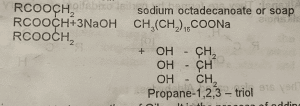
Saponification is the alkaline hydrolysis of fats and oils. When you boil fat or oil with sodium hydroxide (caustic soda) or potassium hydroxide, you get soap and propane-1,2,3-triol (glycerol).
The chemical equation is:
Fat/Oil + Sodium hydroxide → Soap + Glycerol
Ester + 3NaOH → 3 Sodium soap + Propane-1,2,3-triol
Nigerian soap makers use palm oil or palm kernel oil with caustic soda to produce local black soap. The glycerol formed is useful in cosmetics and explosives production. Hard soaps use sodium hydroxide while soft soaps use potassium hydroxide.
2. Hydrogenation
Hydrogenation converts liquid oils into solid fats by adding hydrogen across the double bonds. The process requires:
- Hydrogen gas under pressure (2-3 atmospheres)
- Temperature of 150-200°C
- Finely divided nickel as catalyst
Example reaction:
Groundnut oil (liquid) + Hydrogen → Margarine (solid)
Margarine factories in Lagos and Kano use this process to convert vegetable oils into spreadable margarine. The hydrogenation makes the product solid at room temperature and increases shelf life. Blue Band and Simas margarine are made this way.
Partial hydrogenation leaves some double bonds unchanged, producing a semi-solid fat. Complete hydrogenation converts all double bonds, making a hard, waxy solid.
3. Halogenation (Addition of Halogens)
Unsaturated oils react with halogens like bromine and iodine. The halogens add across the carbon-carbon double bonds.
Example:
Oil + Bromine (brown) → Colorless product
This reaction tests for unsaturation. When you add bromine water to palm oil, the brown color disappears quickly. The speed shows how many double bonds exist. Oils with more double bonds (like groundnut oil) decolorize bromine faster than those with fewer double bonds (like palm oil).
4. Oxidation (Rancidity)
When oils stay exposed to air, they develop bad smell and taste. This is rancidity. Oxygen attacks the double bonds, breaking the oil molecules into smaller compounds with unpleasant odors.
Rancidity happens faster when:
- Oil stays in sunlight
- Temperature is high
- The container is open
- The oil contains more unsaturated fatty acids
Preventing rancidity:
- Store oils in dark bottles away from sunlight
- Keep containers tightly closed
- Add antioxidants like vitamin E
- Refrigerate after opening
- Use within expiry date
Groundnut oil turns rancid faster than palm oil because groundnut oil has more double bonds. This is why palm oil keeps longer in Nigerian markets.
5. Hydrolysis
Fats and oils break down into fatty acids and glycerol when heated with water and acid or enzyme. This is acid hydrolysis.
Equation:
Fat + Water → Fatty acids + Glycerol
In the body, lipase enzyme hydrolyzes fats during digestion. The fatty acids and glycerol are absorbed through the small intestine wall.
Comparison Table: Fats vs Oils
| Property | Fats | Oils |
|---|---|---|
| State at 25°C | Solid | Liquid |
| Source | Mainly animals (butter, lard, tallow) | Mainly plants (palm oil, groundnut, soya) |
| Fatty acid type | Mostly saturated | Mostly unsaturated |
| Melting point | Higher (above 25°C) | Lower (below 25°C) |
| Decolorize bromine water | Slowly or not at all | Rapidly |
| Rancidity rate | Slower | Faster |
| Health effect | Increases cholesterol | Lowers bad cholesterol |
| Examples | Butter, ghee, tallow, lard | Palm oil, groundnut oil, olive oil |
Common Exam Mistakes to Avoid
WAEC Chief Examiner Reports:
- Confusing saponification with hydrolysis: Students write “saponification is breaking down fats with water” instead of specifying alkali (NaOH or KOH). Remember: saponification MUST involve alkali.
- Wrong catalyst in hydrogenation: Many write “iron” or “platinum” instead of nickel. Only finely divided nickel works efficiently for oil hydrogenation.
- Mixing up products: Students write “saponification produces margarine” instead of soap and glycerol. Margarine comes from hydrogenation, not saponification.
- Incomplete equations: Writing only reactants without products. Always complete your chemical equations with all products formed.
- Cannot explain state difference: Simply stating “fats are solid, oils are liquid” without explaining the molecular reason (saturated vs unsaturated fatty acids).
- Wrong rancidity prevention: Writing “add more oil” or “boil the oil” instead of proper methods like adding antioxidants or storing away from light.
Practice Questions
Multiple Choice Questions
- Which catalyst is used in the hydrogenation of oils?
a) Iron
b) Platinum
c) Finely divided nickel ✓
d) Copper - Saponification is the reaction between fat/oil and:
a) Water
b) Acid
c) Alkali ✓
d) Salt - The products of saponification are:
a) Margarine and glycerol
b) Soap and glycerol ✓
c) Fatty acids and water
d) Soap and water - Oils decolorize bromine water faster than fats because oils:
a) Are lighter in weight
b) Contain more double bonds ✓
c) Are from plants
d) Have lower melting points
Essay/Theory Questions
- a) Define saponification. (2 marks)
b) Write a balanced equation for the saponification of fat. (3 marks)
c) State three ways to prevent rancidity in oils. (3 marks)Examiner’s tip: For part (a), you must mention alkali. For part (b), show the full structural equation with glycerol and sodium soap as products. For part (c), give practical methods you can actually do.
- a) Explain why fats are solid at room temperature while oils are liquid. (4 marks)
b) Describe the process of hydrogenation of oils. (4 marks)
c) Give two uses of hydrogenated oils. (2 marks)Examiner’s tip: In part (a), mention saturated vs unsaturated fatty acids and molecular packing. In part (b), state temperature, pressure, and catalyst. Don’t just list points – explain the process.
- a) State four physical properties of fats and oils. (4 marks)
b) Describe a chemical test to distinguish between saturated and unsaturated oils. (3 marks)
c) What is rancidity? (1 mark)
d) State two factors that speed up rancidity. (2 marks)Examiner’s tip: For part (b), describe the bromine water test completely – color change and what it shows. Many students lose marks by just writing “add bromine water” without stating observations.
Memory Aids
Remembering saponification products:
SOAP-G: SOAP and Glycerol
Hydrogenation conditions (HiNT):
- Hydrogen gas
- Nickel catalyst
- Temperature (150-200°C)
Preventing rancidity (DARK-CAT):
- Dark storage
- Antioxidants
- Refrigeration
- Keep container closed
- Check expiry date
- Avoid heat
- Tight seal
Why oils are liquid: “Double trouble bends” – Double bonds create bends in molecules, preventing tight packing, so oils flow.
Related Topics
- Test for Fats and Oil
- Carbohydrates and their classification
- Proteins and amino acids
- Esters and esterification
- Organic chemistry: Addition reactions